
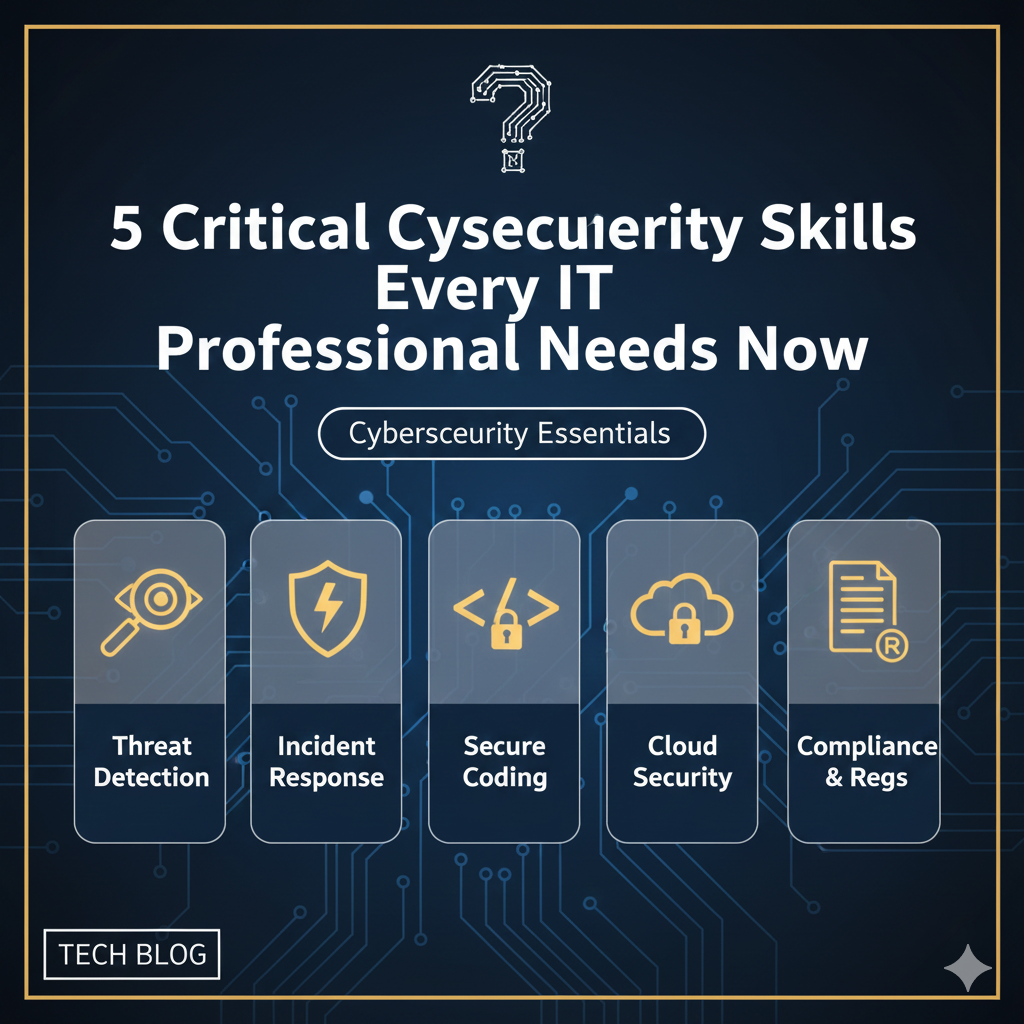
In an era defined by relentless digital transformation, the threat landscape is evolving faster than ever. Cybersecurity is no longer a specialized niche; it has become a foundational, non-negotiable skill for every IT professional, from developers to system administrators. Companies face sophisticated, targeted attacks daily, and they are desperately seeking individuals who can actively safeguard their assets. Investing in these five critical skills is the fastest way to future-proof your career and meet the urgent demand for security expertise.
1. Threat Analysis and Ethical Hacking
This skill moves beyond simply knowing about common attacks; it requires adopting a hacker’s mindset. Threat analysis involves understanding the motives, methodologies, and tools used by malicious actors. You must be able to proactively identify vulnerabilities within systems before they can be exploited. This includes performing vulnerability assessments, penetration testing, and risk modeling. Mastering this domain is crucial for shifting from a reactive defense posture to a proactive, preemptive one.
2. Network Security Fundamentals
The network is the circulatory system of any organization, and securing it is paramount. Professionals must master the core components that govern network traffic and access. This involves:
-
Firewall Configuration: Setting up rules to inspect and filter incoming and outgoing traffic.
-
Intrusion Detection/Prevention Systems (IDS/IPS): Monitoring network activity for malicious patterns and taking automated action.
-
Virtual Private Networks (VPNs): Implementing secure tunnels for remote access and site-to-site connectivity.
A solid grasp of the TCP/IP stack and how to segment networks (Zero Trust Architecture) is essential here.
3. Cloud Security Expertise
The migration of business operations to cloud platforms like AWS, Microsoft Azure, and Google Cloud has introduced a new set of security challenges. Cloud security is a rapidly growing and high-demand field. It requires understanding the Shared Responsibility Model, where security is a partnership between the cloud provider and the customer. Professionals need to secure cloud-native resources, including serverless functions, container orchestration (like Kubernetes), cloud storage, and ensuring compliance within cloud environments.
4. Identity & Access Management (IAM)
IAM is the bedrock of organizational security. It is the framework that ensures the right entities (users, applications, services) have the right access to the right resources, at the right time, and for the right reasons. This involves:
-
Authentication: Verifying a user’s identity (e.g., Multi-Factor Authentication).
-
Authorization: Defining what an authenticated user is permitted to do.
-
Principle of Least Privilege (PoLP): Ensuring users only have the minimum permissions necessary to perform their job.
-
Managing Single Sign-On (SSO) and privileged access management (PAM) solutions.
5. Incident Response and Disaster Recovery
Despite the best prevention efforts, breaches can and do happen. Incident Response is knowing the precise, swift, and coordinated steps to take immediately following a security event to minimize damage, contain the threat, and restore normal operations. This involves a structured process:
-
Preparation: Developing the response plan.
-
Detection & Analysis: Identifying the scope and nature of the attack.
-
Containment, Eradication, & Recovery: Stopping the threat and fixing the affected systems.
-
Post-Incident Activity: Documenting lessons learned.
This skill is crucial for business continuity and demonstrates leadership under pressure.